
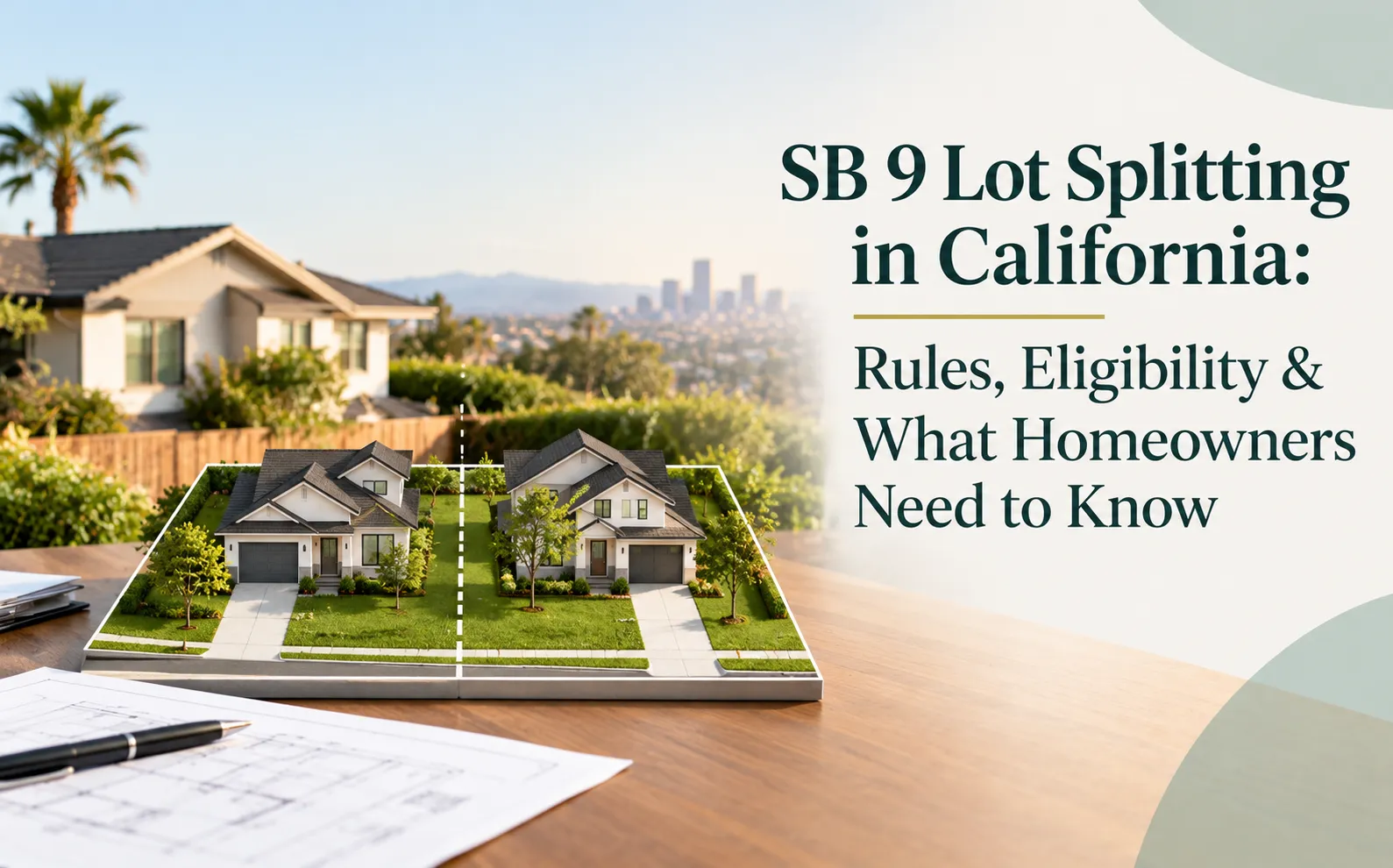
Thinking about turning one California lot into two? You are not alone. Since SB 9 took effect, homeowners across the state have been asking whether they can split their property, build additional homes, and create new value from land they already own.
The answer is often yes, but only if your lot meets specific rules and your plan is set up correctly from the start.
In this guide, our team at XLNC Builder breaks down how SB 9 lot splitting works, who qualifies, which rules matter most, and the costly mistakes to avoid, so you can decide with confidence whether this path fits your property and goals.
What Is SB 9 and Why Does It Matter to Homeowners?
If you own a single-family home in California, you may be sitting on more potential than you realize. Senate Bill 9, which took effect on January 1, 2022, lets eligible homeowners do two things: split one residential lot into two separate parcels, and build up to two units on each resulting lot. In the right situation, that can turn a single property into as many as four homes.
At XLNC Builder, we talk with San Diego homeowners every week who are curious about this law but unsure where to start. Some want to build for aging parents. Some want to create a rental income stream. Others simply want to sell a portion of their land and fund a remodel. SB 9 can support all of those goals, but only if your property qualifies and the plan is set up correctly from day one.
It helps to separate the two parts of the law. An urban lot split divides your existing parcel into two. A two-unit development allows up to two homes on a single-family lot, whether or not you split it. You can use either one on its own or combine them.
Who Is Eligible for an SB 9 Lot Split?
Eligibility is where most homeowners get tripped up, so go through this list carefully before spending money on plans.
Your property must meet these basic conditions:
- It must be zoned for single-family residential use.
- It must be located in an urbanized area or urban cluster, as defined by the U.S. Census Bureau.
- The parcel must be large enough to be divided into two lots, each at least 1,200 square feet, with neither new lot smaller than 40 percent of the original lot area. In practice, that means a split no more lopsided than 60/40.
- You must sign an affidavit stating you intend to live in one of the homes as your primary residence for at least three years after the split is approved. This applies to individual owners, with limited exceptions for certain nonprofit or community land trust applicants.
Your property will likely be excluded if it falls into any of these categories:
- Prime farmland or land with certain agricultural protections
- Wetlands
- Very high fire hazard severity zones, unless specific mitigation requirements are met
- Hazardous waste sites that have not been cleared
- Earthquake fault zones and certain flood zones, unless protective requirements are satisfied
- Land under conservation easements or protected habitat plans
- Historic properties or parcels within a designated historic district
San Diego has a lot of hillside and canyon-adjacent lots, so the fire zone and habitat rules deserve a close look. A quick parcel check with your local planning department can save you months of effort.
Key SB 9 Lot Splitting Rules You Should Know
Once you confirm eligibility, these are the rules that shape what you can actually build.
Ministerial approval. Cities must review SB 9 applications using objective standards, without a public hearing or discretionary review. That makes the process more predictable than a typical zoning change.
Setbacks. Local governments cannot require side or rear setbacks of more than four feet for new units. Existing structures, or new ones built in the same footprint, may not need new setbacks at all.
Minimum unit size. Cities cannot apply standards that prevent you from building at least two units of 800 square feet each.
Parking. Generally, a maximum of one parking space per unit can be required. No parking is required if you are within a half mile of a major transit stop or in a car share zone.
Tenant and demolition limits. You cannot use SB 9 if the project would demolish or alter housing that is restricted for affordable or moderate income households, housing subject to rent control, or a unit that has been occupied by a tenant in the past three years. Demolishing more than 25 percent of the existing exterior structural walls also triggers extra restrictions.
No repeat splits. A lot that was created through an SB 9 split cannot be split again, and the same owner (or someone acting with them) cannot use SB 9 to split an adjacent parcel.
Short-term rentals are off the table. Units created under SB 9 must be rented for terms longer than 30 days.
One more note: California passed follow-up legislation in 2024 that clarified how cities must process SB 9 applications. Local rules continue to evolve, so always confirm current requirements with your city before you finalize a plan.
How SB 9 Works With ADUs
This is a common point of confusion. If you do both a lot split and a two-unit development, cities are allowed to cap the total at two units per lot, which can include ADUs and junior ADUs. If you only build on a single unlotted parcel under SB 9, your options may look different.
Many homeowners find that an ADU is the simpler, lower-cost route, especially if they do not need to sell land. Our guide to San Diego ADU rules in 2026 walks through what you can build on your lot without a split. If you already have a detached garage, our breakdown of garage conversion ADUs in San Diego shows another path that often costs less than new construction.
The Step-by-Step Process for a Lot Split
Every city handles the details a little differently, but most SB 9 lot splits follow this general path:
- Check zoning and eligibility. Confirm your parcel is single-family zoned and not in an excluded area.
- Order a boundary and topographic survey. A licensed surveyor maps your property lines, easements, and slopes.
- Hire a civil engineer or land planner. They prepare the tentative parcel map and verify that each new lot can access utilities and a public street.
- Plan the homes. Decide whether you will keep the existing house, add units, or build new. This is where an architect and builder should be involved early.
- Submit the application. File the parcel map and the owner occupancy affidavit with your city.
- Record the final map. After approval, the map is recorded with the county and the two lots become legally separate.
- Pull building permits and build. Each new home goes through standard plan checks and inspections.
Utility connections often cause the biggest surprises. Separate water, sewer, and electrical service for a new lot can add real cost, so ask about them early.
What Does It Cost and What Should You Budget For?
Costs vary widely by lot, but think in three buckets: pre-development (survey, engineering, city fees), site work and utilities, and the construction itself. Many homeowners focus only on the build and get caught off guard by the first two.
To get a realistic picture of construction spending, our guide to home remodel costs in San Diego is a good benchmark. If you are weighing SB 9 against a simpler backyard unit, the ADU construction guide for San Diego can help you compare timelines and budgets side by side.
Common Mistakes Homeowners Make
- Skipping the feasibility check. Fire zones, easements, and slope can quietly kill a project. Verify first.
- Ignoring the owner occupancy requirement. If you plan to sell both lots right away, SB 9 may not be the right fit.
- Underestimating utilities. Trenching, new meters, and sewer laterals are rarely cheap.
- Designing before confirming local standards. Objective standards differ by city, so plans should match your jurisdiction.
- Assuming the lender will cooperate. Financing a lot split can be more complex than a standard remodel loan, so talk to lenders early.
Is SB 9 Right for You?
SB 9 is a powerful tool, but it is not for everyone. It tends to work best for homeowners with generous lots, clear access, and a long-term plan, whether that means multigenerational living, rental income, or building equity. If your lot is small or constrained, a single ADU may deliver most of the benefit with far less complexity.
The best first step is an honest conversation about your property and your goals. Our team at XLNC Builder helps San Diego homeowners evaluate what is realistically buildable, from design through construction, so you can make decisions with clear numbers instead of guesses. Reach out for a free consultation at (619) 836-0099 or through our contact page.
Frequently Asked Questions
Can I split my lot under SB 9 and sell one of the parcels?
Yes, but there is a catch. As an individual owner, you must sign an affidavit saying you will live in one of the homes as your primary residence for at least three years after the split is approved. Selling a vacant or developed parcel is allowed, but the owner occupancy commitment still applies.
How many homes can I build after an SB 9 lot split?
Generally, up to two units per resulting lot, for a total of four across both lots. However, cities may limit the total to two units per lot when ADUs and junior ADUs are counted, so check your local rules.
Does SB 9 apply to every single-family lot in California?
No. The lot must be in a single-family zone within an urbanized area, and properties in excluded areas such as very high fire hazard zones, wetlands, historic districts, and certain flood or fault zones may not qualify.
Can my city deny an SB 9 application?
Cities must approve qualifying projects ministerially, using objective standards. They can only deny a project if they find a specific, adverse impact on public health and safety that cannot be mitigated. They cannot deny it simply because they dislike the project.
Do I need an architect or builder before applying for a lot split?
The parcel map itself is usually prepared by a surveyor and civil engineer, but involving a design-build team early is smart. It helps you confirm what is buildable, set realistic budgets, and avoid designs that conflict with setbacks, utilities, or local standards.
Planning a build or remodel in San Diego?
Get a free, no-pressure consultation and a transparent quote from XLNC Builder: licensed, insured, and local to San Diego.
Get a Free Quote