
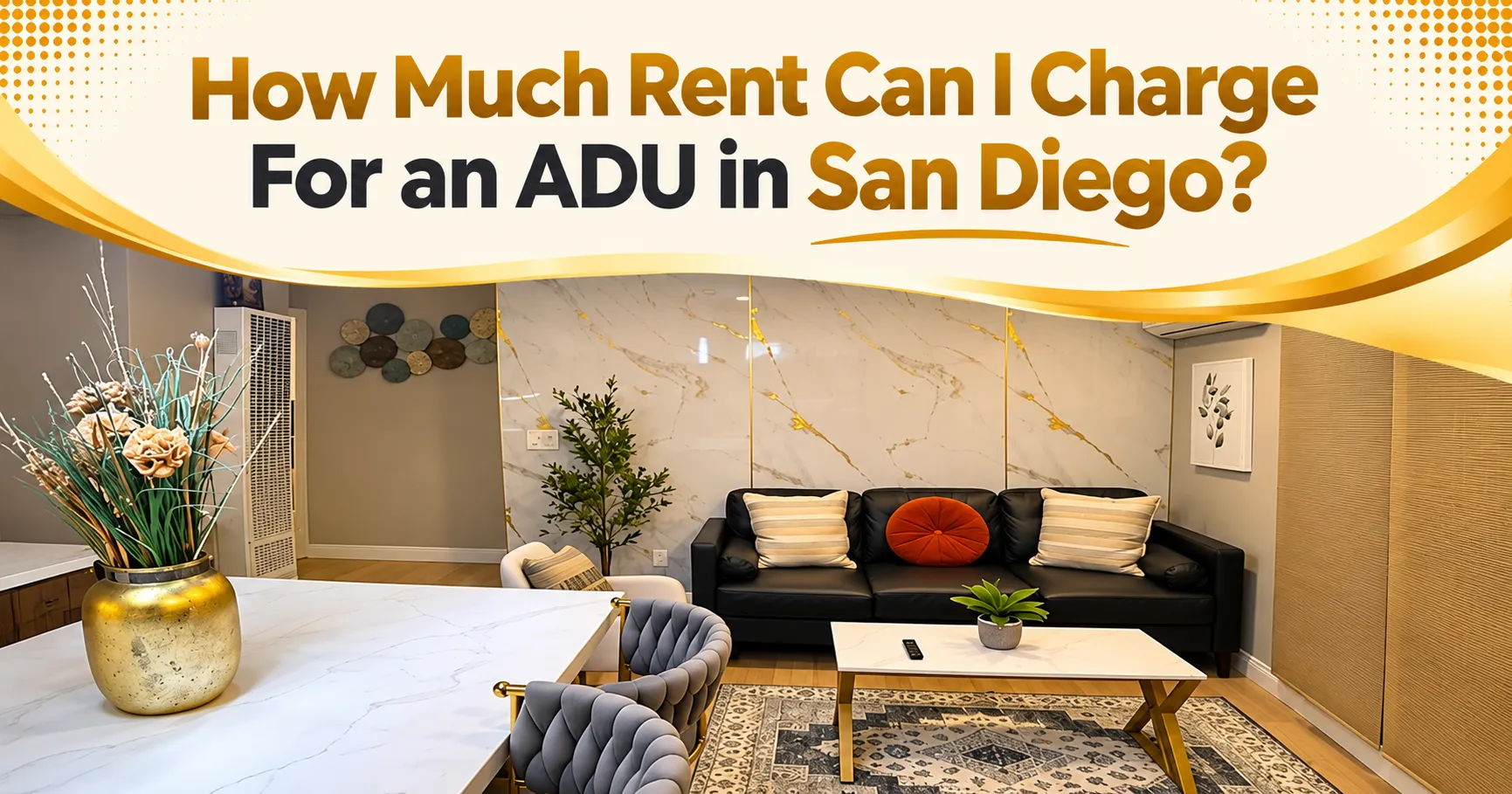
Every homeowner who calls us asks some version of the same question: does an ADU actually pay for itself, or is it a lifestyle purchase dressed up as an investment? The honest answer is that it depends on the numbers — and the numbers are knowable before you spend a dollar. Here is the payback math the way we run it with clients at our Mira Mesa office, using our real starting rates and real San Diego rents.
The Build Cost — Start Here, Not With the Rent
A new detached ADU in San Diego starts at $300 per square foot for 600 square feet and up and $350 per square foot under 600 — our starting construction rate at XLNC. Work it out for the sizes we build most:
| Unit | Size | Starting construction cost |
|---|---|---|
| Studio | 450 sq ft | $157,500 (at $350/sq ft) |
| One-bedroom | 600 sq ft | $180,000 (at $300/sq ft) |
| Two-bedroom | 800 sq ft | $240,000 (at $300/sq ft) |
| Two-bedroom, large | 1,200 sq ft | $360,000 (at $300/sq ft) |
Those are starting construction costs. Design, permits, site work, and a 10 to 15 percent contingency sit on top — so a 600-square-foot one-bedroom is realistically a $210,000 to $230,000 all-in project on a flat lot, and more on a sloped one. Cheaper routes exist: a garage conversion at $80,000 to $150,000, or a junior ADU at $40,000 to $80,000. For the full breakdown, read our real ADU cost numbers.
The Rent Payback — the Number That Decides Most Jobs
A well-built San Diego ADU can rent for up to $3,500 a month depending on size and neighborhood. Run the payback on the 600-square-foot one-bedroom at a realistic $2,400 a month:
Gross rent: $2,400 × 12 = $28,800 a year. Against a $220,000 all-in cost, that is a gross payback of about 7.6 years — before expenses. Now take out the real costs: vacancy (budget 5 percent, about $1,440), maintenance and turnover (budget $1,500 to $2,000 a year), insurance increase, and property tax on the added value. Net, you are looking at roughly $23,000 to $24,000 a year, which puts the honest payback at 9 to 10 years on a detached one-bedroom in a good rental neighborhood.
That is the number most builders will not show you. It is also a good number — a 9-to-10-year payback on an asset that lasts 50 years, in a city where rents rise and land does not get cheaper. The payback is faster on the cheaper routes: a $110,000 garage conversion renting at $2,000 a month pays back in roughly 5 to 6 years net. It is slower on the big detached two-bedroom, where the per-foot rate is the same but the rent does not scale with it. Size is a lever — the 600-to-749-square-foot one-bedroom is our most-built size for a reason: it sits under the 750-square-foot impact-fee exemption and rents nearly as well as a larger unit.
The Value Lift — What an Appraiser Actually Counts
Rent is only half the return. The other half is what the ADU does to the property's value, and here the news is mixed in a way that matters. An appraiser values an ADU three ways: the cost approach (what it cost to build, depreciated), the income approach (what it earns, capitalized), and comparable sales (what similar properties with ADUs sold for). In San Diego, comparable sales with permitted ADUs are still thin — the market is young — so appraisers lean on cost and income, and both tend to come in below what the owner feels the unit is worth.
What that means in practice: if you build a $220,000 ADU, do not expect the appraisal to add $220,000 to the property value the day it is finished. A realistic expectation is a lift in the range of 60 to 80 percent of build cost in the early years, rising as more ADU sales close and the comparable-sales pool deepens. The income approach helps — a unit earning $28,800 a year gross supports real value — but appraisers discount it for vacancy and expenses, just as you should.
Two things protect the value lift. First, permit it properly: an unpermitted unit adds almost nothing to an appraisal and can subtract value when a buyer or lender discovers it. Second, build for the neighborhood: a 1,200-square-foot luxury unit on a street of 900-square-foot homes will not appraise like one on a street where it fits. The best ROI in San Diego right now is a well-built, right-sized unit in a strong rental neighborhood — Scripps Ranch, Rancho Bernardo, Mira Mesa — not the biggest unit you can fit.
When an ADU Does NOT Pay
Three cases where we tell homeowners to wait. One: you are borrowing at a high rate and the loan payment eats the rent — if the monthly loan payment is higher than the net rent, the unit is a cost, not an investment, until rates or rents move. Two: the lot fights you — a steep slope, a bad slab, a long utility run — and site work pushes the all-in cost 30 percent above the table above. Three: you need the money back in under five years. An ADU is a 10-year investment with a 50-year asset behind it; if your horizon is short, the math does not have time to work. In all three cases, the honest advice is the same: wait, or build the cheaper route. A garage conversion or a JADU can be the right answer while a detached unit is not.
If you want the math run on your lot — real cost, real rent for your ZIP, real payback — bring your lot address to our office for a free Backyard Report check. We will show you the numbers before you commit to anything.
Regards, INIT XLNC Builder 9400 Activity Rd, Suite G, San Diego, CA 92126 +1 (619) 836-0099
Frequently Asked Questions
How long until an ADU pays for itself in San Diego?
On a detached one-bedroom at realistic rents, expect a net payback of about 9 to 10 years. A garage conversion pays back faster — roughly 5 to 6 years — because it costs less to build.
Does an ADU increase my property value?
Yes, but not dollar-for-dollar at first. Expect a value lift of roughly 60 to 80 percent of build cost in the early years, rising as more ADU sales close and appraisers get better comparable sales.
Does an ADU raise my property taxes?
Yes — the added structure is reassessed. The land is not reappraised, only the new improvement, under California's Proposition 13 rules.
Is an ADU a good investment in San Diego?
For most owners with a 10-year horizon and a lot that builds cleanly, yes: strong rents, rising land values, and a 50-year asset. It is a poor investment if you borrow at a high rate, the lot needs heavy site work, or you need the money back quickly.
Run the Payback Math on Your Lot
Get a free, no-pressure consultation and a transparent quote from XLNC Builder: licensed, insured, and local to San Diego.
Get a Free Quote