
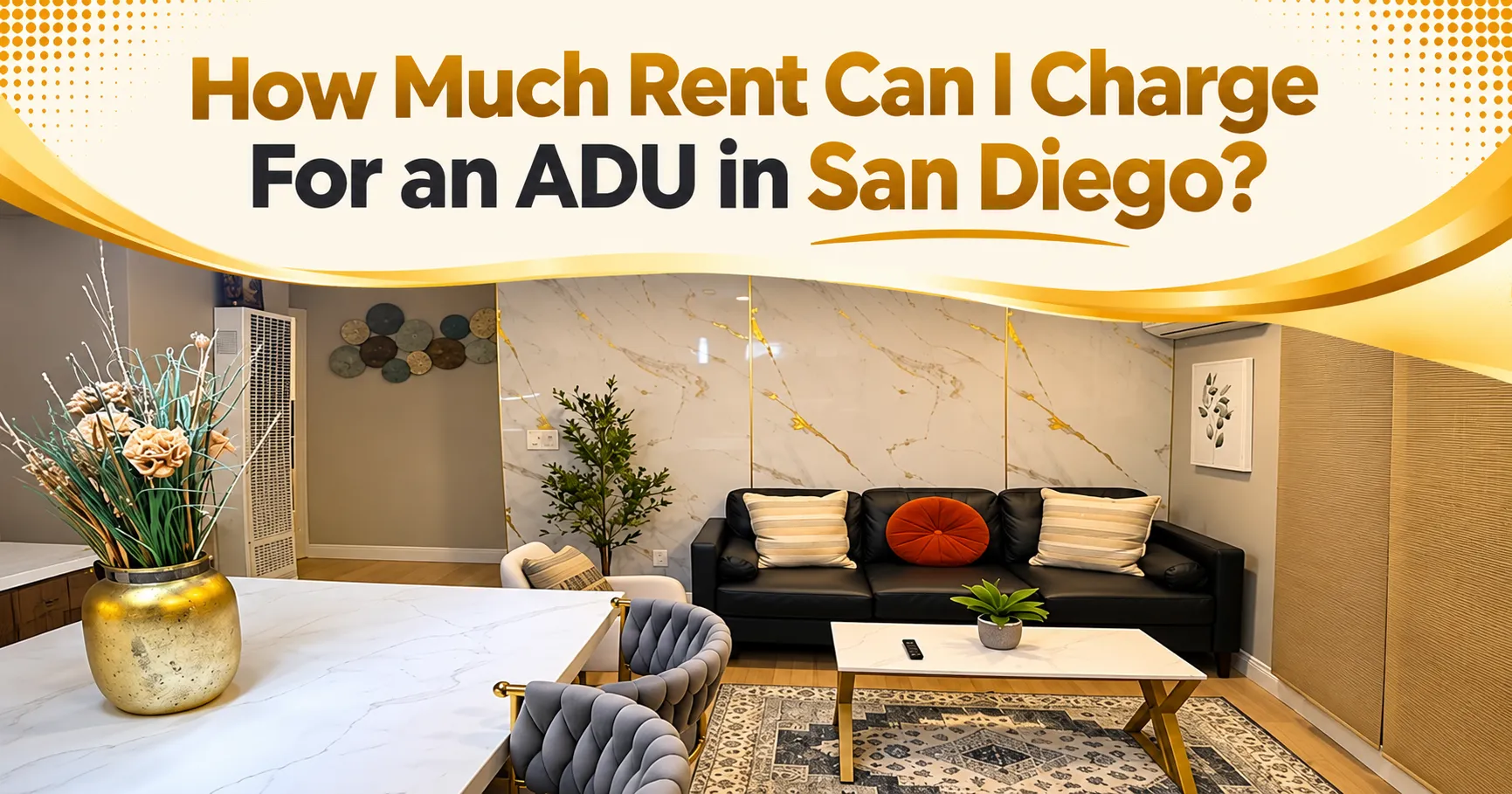
An accessory dwelling unit (ADU) can turn unused space on your property into steady monthly income. But before you build, you need a realistic answer to one question: how much rent can you actually charge?
This guide breaks down current ADU rent in San Diego by unit size and neighborhood, explains what moves your price up or down, and covers the California rules every ADU landlord should know.
Quick Answer: What Does an ADU Rent for in San Diego?
In 2026, most permitted ADUs in San Diego rent for roughly $1,500 to $3,500 per month. Where your unit lands in that range depends mostly on size, location, and finish quality.
| ADU Type | Typical Size | Estimated Monthly Rent |
| Studio | 350 to 500 sq ft | $1,500 to $2,200 |
| 1 Bedroom | 500 to 750 sq ft | $2,000 to $3,200 |
| 2 Bedroom | 750 to 1,200 sq ft | $2,800 to $3,800 |
These are planning estimates, not guarantees. Rents shift with the market, and a well-designed detached unit in a desirable area can beat the top of these ranges.
What the San Diego Rental Market Looks Like Right Now
San Diego remains one of the most expensive rental markets in the country. Average apartment rents across the city sit in the mid $2,000s for a one-bedroom and roughly $3,000 for a two-bedroom, depending on the data source.
The market has cooled a little from its peak, though. Vacancy has crept up in 2026 and rents have been mostly flat, so pricing your ADU at what the market will actually pay matters more than it did a few years ago. A unit priced too high can sit empty for weeks, and every vacant month costs more than a small rent discount would.
The good news for ADU owners is that a new, private, well-built unit often earns a premium over older multifamily apartments of similar size.
7 Factors That Decide How Much Rent You Can Charge
1. Location
Neighborhood is the biggest driver. Coastal and central areas such as Pacific Beach, La Jolla, Mission Hills, and North Park command the highest rents. Inland and south county areas such as Chula Vista, National City, and Lemon Grove typically rent for less. A studio ADU that earns about $1,200 to $1,700 in south county can reach $1,800 to $2,200 or more near the coast.
2. Size and Layout
More square footage means more rent, but layout matters as much as size. A true one-bedroom with a separate sleeping area rents for noticeably more than an open studio of similar square footage.
3. Detached vs. Attached or Converted
A detached backyard ADU feels like a small home and usually earns the most. Garage conversions and attached units tend to rent for a bit less, but they cost less to build, which can improve your overall return.
4. Privacy and Entrance
A private entrance, a separate patio, and good separation from the main house are strong selling points for tenants.
5. Finishes and Appliances
Modern kitchens, quality flooring, good lighting, and in-unit laundry all support higher rent and attract longer-term tenants.
6. Parking and Amenities
Off-street parking is a real advantage in San Diego. Air conditioning, storage, and outdoor space also help.
7. Condition and Energy Efficiency
A brand new unit with efficient systems keeps tenant utility bills lower, which makes your asking rent easier to justify.
California Rules Every ADU Landlord Should Know
Setting the right rent is only part of the picture. Keep these rules in mind:
- 30-day minimum rental term. State law does not allow ADUs to be rented for terms of 30 days or less, so nightly short-term rentals are off the table.
- Annual rent increase limits. Many California rentals fall under the state's tenant protection law (AB 1482), which limits yearly increases. Some owner-occupied properties may qualify for exemptions, so confirm how it applies to your property.
- Security deposit limits. California generally caps deposits at one month's rent, with limited exceptions for small landlords.
- Proper lease and notices. Use a written lease and follow state rules for notices, entry, and habitability.
Rental law changes often. Check current requirements with a qualified landlord-tenant attorney before you sign your first lease.
How to Set the Right Rent for Your ADU
- Pull comparable listings. Search for similar size units within about a mile of your home. Include apartments, ADUs, and small rental homes.
- Check price per square foot. Smaller units usually rent for more per square foot than larger ones, so compare units of similar size.
- Adjust for your advantages. Add value for a private yard, parking, new construction, or in-unit laundry.
- Start at market, not above it. A fair price fills the unit faster and attracts better tenants.
- Review yearly. Revisit your rent each renewal, keeping within legal increase limits.
Smart Ways to Earn More From Your ADU
A few design decisions made before construction can lift your rent for years:
- Add a real bedroom instead of an open studio when the footprint allows it
- Include in-unit washer and dryer hookups
- Install efficient heating and cooling
- Create built-in storage so a small unit lives larger
- Give the unit its own entrance and outdoor space
- Choose durable, attractive finishes that hold up to tenant wear
These choices work best when they are planned into the design from day one, which is one reason many homeowners work with a design-build team. If you are still weighing the numbers, our guide on how much it costs to build an ADU in San Diego shows what different unit types typically cost, so you can compare build cost to expected rent.
Matching Your ADU Type to Your Rental Goals
Your rent potential and your build budget go hand in hand. A garage conversion costs less than a new detached unit, so it can reach a positive return sooner even if the monthly rent is a little lower. You can learn what to expect in our breakdown of garage conversion ADUs.
A larger detached ADU costs more up front, but it can earn higher rent and add more long-term property value.
To estimate your return, multiply your expected monthly rent by 12, subtract property tax changes, insurance, maintenance, and a vacancy allowance, then compare the result to your total project cost.
Know the Rules Before You Build
Your rent estimate only matters if the ADU can legally be built on your lot. Size limits, setbacks, and height rules all affect what you can build and therefore what you can charge. Review the latest San Diego ADU rules for 2026 and the step-by-step ADU permit process so you can plan realistic timelines and avoid delays that cost you rental income.
A permitted, code-compliant unit is also the only kind you can legally rent, so skipping the permit is never worth the risk.
Choose the Right Builder to Protect Your Rental Income
A delayed or poorly built ADU means lost rent and expensive fixes. Before you hire anyone, read our list of questions to ask an ADU contractor in San Diego so you can compare builders on licensing, pricing, timelines, and warranties.
XLNC Builder is a licensed San Diego design-build contractor (CSLB Lic. #1153455) that handles ADU design, permitting, and construction under one roof.
Ready to See What Your ADU Could Earn?
Every lot is different, and the best rent estimate starts with your property. Contact XLNC Builder for a free consultation and a transparent quote. Call (619) 836-0099 or visit xlncbuilder.com to get started.
Frequently Asked Questions
1. How much rent can I charge for an ADU in San Diego?
Most permitted ADUs in San Diego rent for about $1,500 to $3,500 per month in 2026. Studios usually fall between $1,500 and $2,200, one-bedrooms between $2,000 and $3,200, and two-bedrooms between $2,800 and $3,800, depending on location and finish quality.
2. Can I rent my ADU on Airbnb in San Diego?
No. California law does not allow ADUs to be rented for terms of 30 days or less. Your ADU must be offered as a long-term rental, which also gives you steadier income and fewer vacancies.
3. Is ADU rental income taxable?
Yes. Rental income is generally reported on your federal and California tax returns, though you may be able to deduct expenses such as insurance, maintenance, and depreciation. Speak with a CPA to understand your situation.
4. How long does it take for an ADU to pay for itself?
Payback depends on your build cost, rent, and expenses. A lower-cost garage conversion can pay back faster than a larger detached unit. Compare your total project cost with your expected annual net rent to estimate your timeline.
5. Are there limits on how much I can raise ADU rent each year?
Often yes. Many California rentals fall under statewide limits on annual rent increases, although some owner-occupied properties may be exempt. Confirm which rules apply to you with a landlord-tenant attorney before raising rent.
Planning a build or remodel in San Diego?
Get a free, no-pressure consultation and a transparent quote from XLNC Builder: licensed, insured, and local to San Diego.
Get a Free Quote